The Sunday night blues on the grid
Sunday nights have a particular kind of quiet.
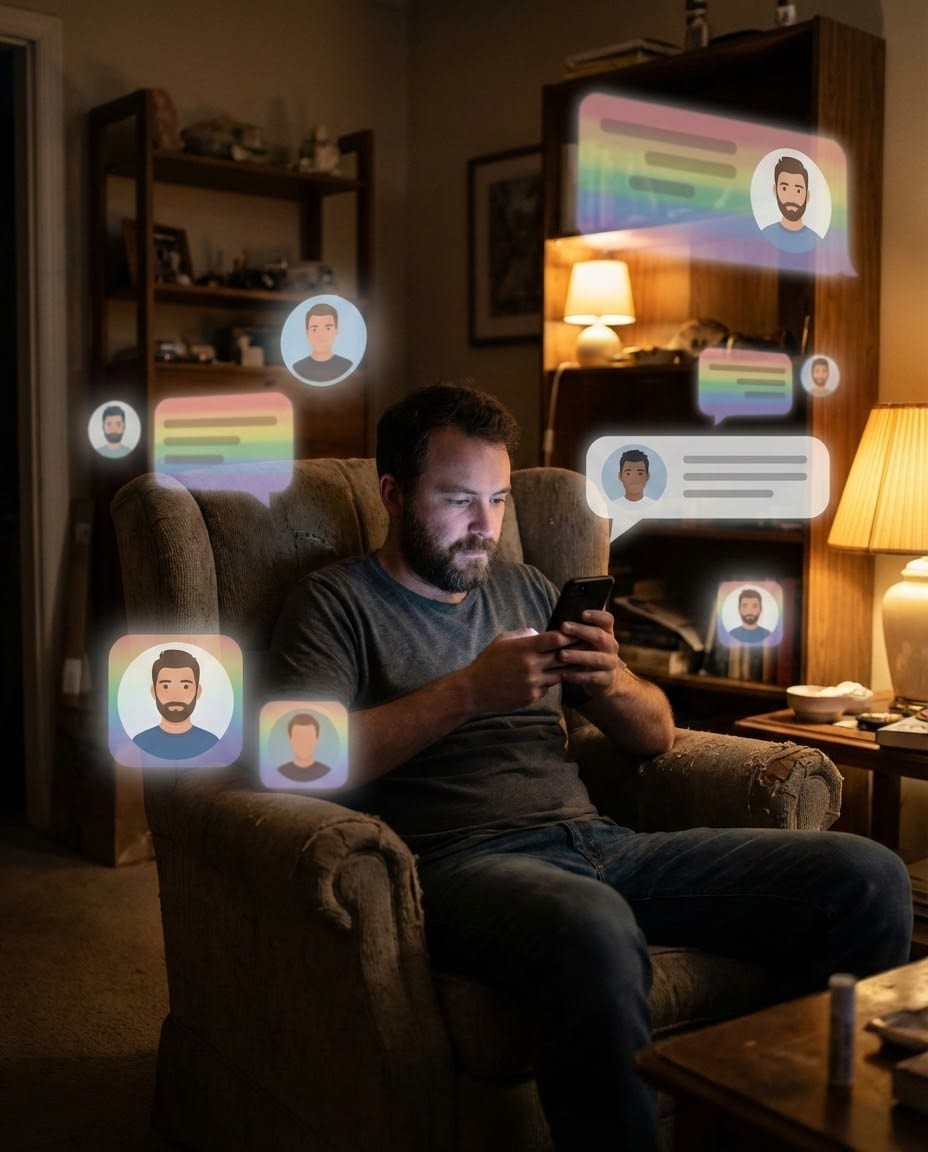
It’s not always dramatic. Sometimes it’s just that familiar heaviness in your chest when the weekend energy fades and the week ahead feels too loud, too long, too performative in modern queer dating. You open your phone. You open Splashd (or any app—especially now that the “gay app” isn’t just gay anymore). And suddenly you’re looking at a sea of faces—some smiling, some shirtless, some “hey”ing their way into your DMs.
And yet: you still feel alone.
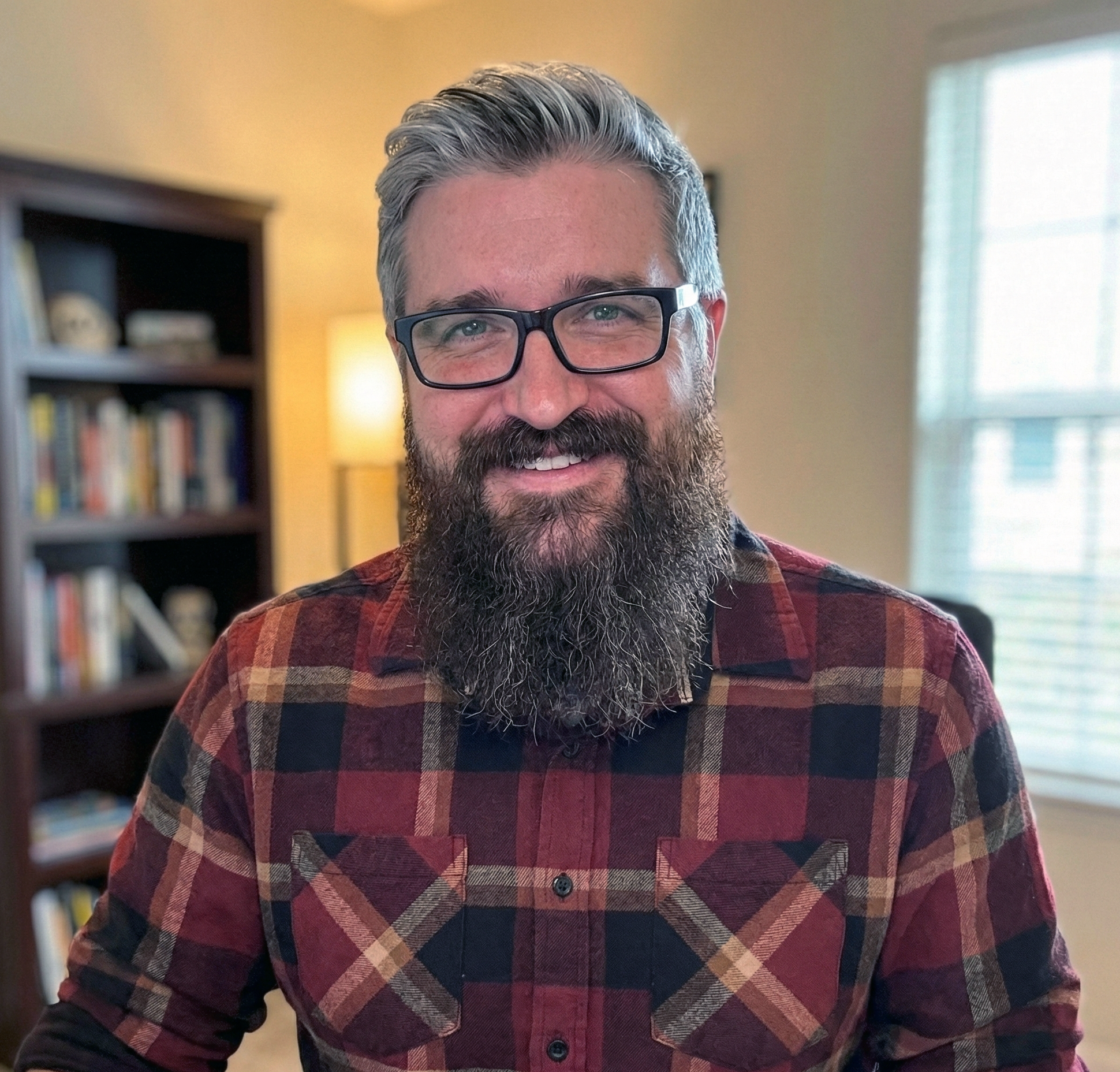
I’ve felt it too. Not just as a queer person, but as the founder and CEO of Splashd—someone who spends his days thinking about what connection should look like in a location-based LGBTQ+ space. There’s a contradiction at the heart of modern queer social life: we can be surrounded by options and still starve for belonging.
This is the loneliness paradox. And it’s not a personal failure. It’s a cultural and psychological collision: minority stress, modern dating design, the dopamine economy, and the deeply human need to be known—not just noticed.
Read this before we go deeper
If any part of this topic touches something tender for you, you’re not “too sensitive.” You’re paying attention—and that’s a strength.
What we know about the loneliness epidemic
Loneliness isn’t just “not having a partner.” It’s the felt sense that your relationships—romantic, sexual, platonic, chosen family—don’t have the depth, reliability, or safety you need.
For LGBTQ+ people, loneliness can be intensified by years of subtle (and not-so-subtle) messaging that we’re “too much,” “not normal,” or only lovable under certain conditions. And the mental health data behind this is sobering.
Different studies report different ranges depending on sample and methodology, but the signal is consistent: queer men (and many LGBTQ+ folks across identities) are carrying disproportionate mental health burdens. Loneliness isn’t a minor side effect—it’s often a major mechanism.
I’m including that here because a post about loneliness shouldn’t pretend this is just “vibes.” For some of us, it’s survival.
The science of isolation in a hyper-connected world
Here’s the core problem: digital proximity creates the appearance of community without consistently delivering the experience of community.
The dopamine loop: why the grid can feel like a slot machine
Most dating/social apps (including the ones with good intentions) are built around fast feedback—and a layer of emojis, tribes, and signals that can be surprisingly hard to read when you’re already emotionally tired. Over time, those micro-signals can train your brain to seek more input than your nervous system can actually digest:
- views
- taps
- messages
- matches
- “online now”
That’s not necessarily pleasure—it’s anticipation. Dopamine isn’t the “happiness chemical.” It’s the “seeking” chemical. It keeps you scanning, refreshing, checking, hoping.
And when a system trains your brain to seek, it can also train your body to feel unsettled when nothing lands. This is how you can spend an hour “socializing” and still end up feeling more alone.
Why heavy app use can lower community feelings
Research has increasingly linked heavy dating app use with a lower sense of community, increased loneliness, and more comparison (“Why am I not getting what they’re getting?”). That doesn’t mean apps are evil. It means they’re powerful—and power needs intention.
Here are a few signs the grid is amplifying loneliness rather than relieving it:
- You open the app for connection and leave feeling judged.
- You keep scrolling even after you realize you’re not enjoying it.
- You interpret silence as a verdict on your worth.
- You feel lonelier after “successful” attention than before.
That last one confuses people the most—so let’s name what’s happening underneath.
Internal conflicts that keep us lonely—even when we’re not alone
A 2025 systematic review highlighted three primary drivers of LGBTQ+ loneliness: internalized homophobia, fear of rejection, and concealment.
If you’ve ever thought, “I’m out, I’m fine, I’m having sex—why do I still feel empty?” this section is for you.
Internalized homophobia isn’t always obvious
Internalized homophobia doesn’t always show up as “I hate being gay.” More often it shows up as patterns you can easily mistake for personality: chasing validation from emotionally unavailable people to “prove” something, feeling shame after desire even when the sex was consensual and wanted, treating vulnerability like a liability, or keeping relationships at the “safe” level of banter and bodies.
In other words: you can be socially active and emotionally isolated at the same time.
Fear of rejection can make your nervous system treat every chat like a performance review. Concealment can make you feel like you’re living two lives—one online and one “real”—with neither fully held.
A gentle reframe
Loneliness isn’t always about the absence of people. Sometimes it’s about the absence of safety to be fully seen.
I’ve heard versions of this from so many people in our community. One message has stayed with me.
“I can pull a date in an hour, but I can’t find someone to actually talk to. It’s like my body is visible but my life isn’t.”
If that lands, you’re not broken. You’re describing a design mismatch: apps are efficient at surfacing availability, but not always structured to support attachment.
The hookup fallacy: when sex becomes a stand-in for connection
Let’s say something clearly, with zero shame: hookups can be healthy. Many of us have found joy, exploration, confidence, and healing through consensual sex—including in monogamish dynamics without blurry lines.
The fallacy isn’t “hookups are bad.” The fallacy is believing: If I have sex, I won’t feel lonely.
Sexual release and social connection are different systems
Sex can calm your body, boost mood temporarily, help you feel desired, and offer pleasure and exploration. Connection does something different: it regulates your nervous system long-term, builds meaning and belonging, provides reliability and care, and helps you feel known—not just wanted.
So if you use sex to treat loneliness, sometimes it works for a night. But if your deeper need is belonging, the loneliness often returns—sometimes louder—because the underlying need wasn’t met.
A simple self-check
Before you say yes, ask: “Am I choosing this from desire, or from panic?”
Desire is allowed. Panic deserves care first.
The nuance research points to (and how to use it)
Here’s a crucial nuance from the research landscape: using apps specifically for sexual encounters can correlate with higher self-esteem if the user separates their self-worth from the outcome.
That “if” is doing a lot of work.
The difference is not whether you hook up. The difference is whether you’re using the grid as a tool (to meet needs you choose) or a mirror (to judge your worth).
When the app becomes a mirror, every “no,” every ghost, every slow night becomes a story: “I’m not enough.” When the app is a tool, those same moments become information: “Not a match. Not my person. Not tonight. Still worthy.”
The outcome-independence script (try this before you open the app)
Say (out loud if you can): “My worth is not up for negotiation tonight. I’m here to explore connection, not audition for love.”
Then choose one intention—chat, friends, date, or hookup—and let that guide your next ten minutes.
Wildflowering: slow growth in a fast-scroll world
In Splashd team conversations, we’ve used the phrase wildflowering to describe a kind of connection that doesn’t force itself open on a timer. Wildflowers don’t bloom because someone yells at them. They bloom because the conditions are right.
Wildflowering is the opposite of “maximize matches.” It’s prioritizing conditions that make intimacy possible—even in small doses.
What wildflowering looks like in practice
Wildflowering often looks less like “more” and more like “deeper”: a slower pace over constant swiping, a smaller circle over a bigger audience, and consistent micro-connections over random bursts of attention.
It’s also a boundary with your own nervous system. If you’re feeling lonely, your brain may push you toward more stimuli (more profiles, more chats). But what tends to relieve loneliness is usually less stimulation and more meaning.
Here’s a tiny practice I use on weeks when I feel that Sunday-night ache: I open the app with a ten-minute timer, I send two messages that are actually about the person (not just “hey”), and then I log off to do one grounding thing—shower, tea, music, a walk, or texting a friend who’s safe.
That’s not “quitting the app.” That’s using it with self-respect.
Wildflowering isn’t about becoming less social. It’s about becoming more intentional.
Third spaces: why offline life still matters
Sociologists often call them third spaces: places that are not home (first space) and not work (second space), where you can be a person among people.
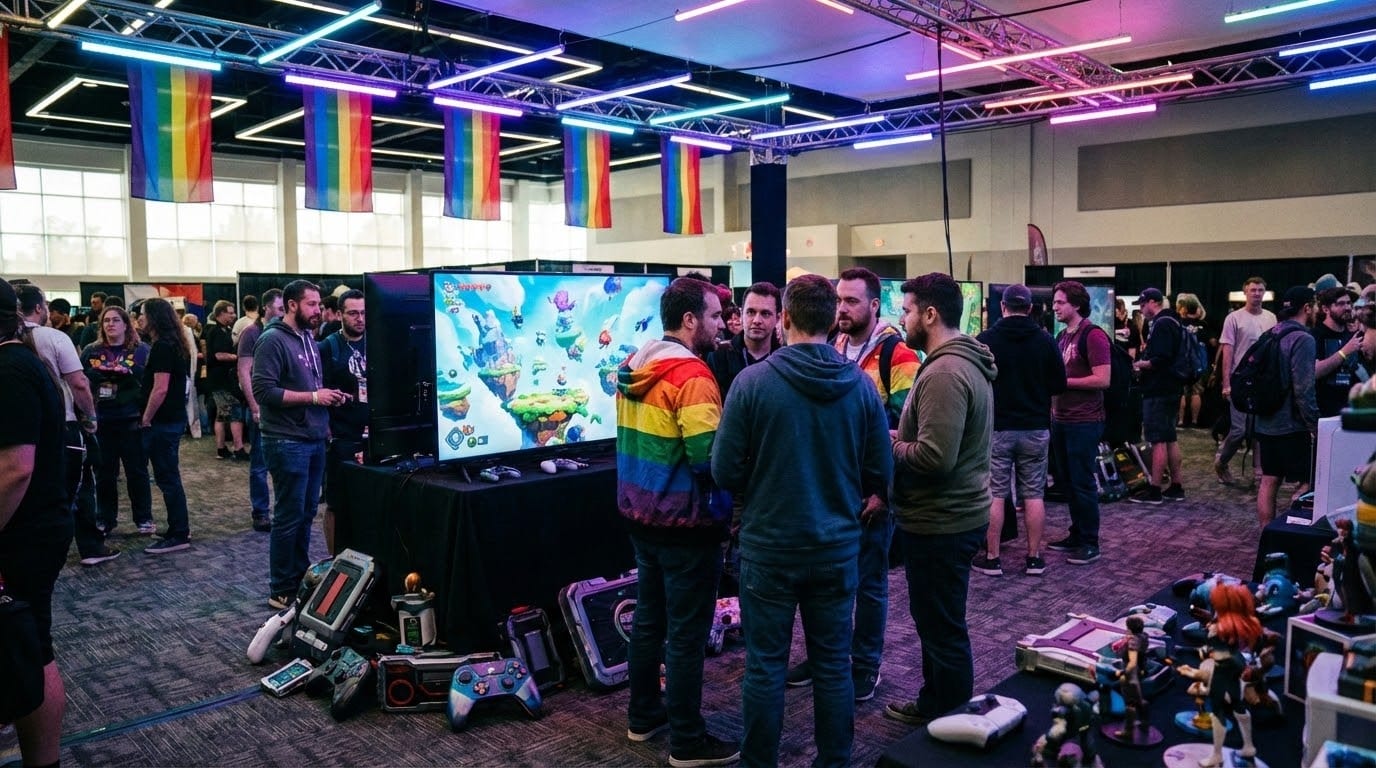
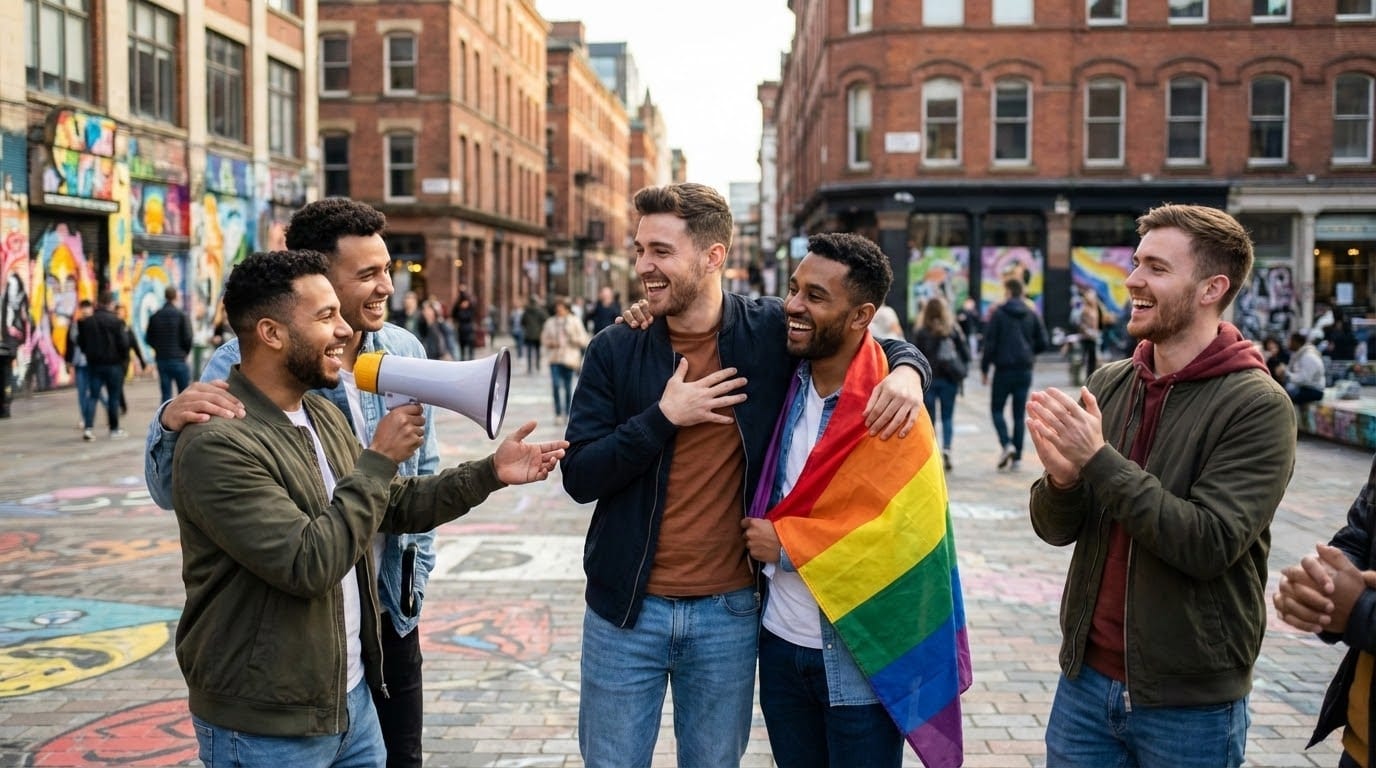
For queer folks, third spaces have historically been everything—yes, bars, but also bookstores, sports leagues, faith groups, crafting circles, mutual aid, community centers, drag brunches, choirs, hiking groups, and game nights.
Here’s the key: third spaces create ambient belonging. You don’t need to “win” someone’s attention in a DM to feel part of a room.
Digital tools should lead somewhere
If an app is only a destination, it can become a loop. If an app is a bridge, it can become a life.
So the practical question becomes: how do we turn “nearby” into “connected”?
One approach is to use the app to find one person who might be down for something low-pressure, choose an activity with built-in conversation (a walk, museum, queer market, trivia night), and keep the first hang short. Short is often sustainable—especially when you’re rebuilding social capacity.
If you live in a place with limited LGBTQ+ spaces, third spaces can be small: a consistent coffee shop, a volunteer shift, a fitness class where you learn names over time. The goal isn’t instant intimacy. The goal is repetition, because repetition builds familiarity, familiarity builds safety, and safety makes connection possible.
Use this as a prompt (not a literal instruction)
Wherever you are, ask: Where can I belong without performing? Then choose a place you can return to—weekly, not perfectly.
Vulnerability: the simplest loneliness antidote we avoid
If fear of rejection is a driver of loneliness, it makes sense that we’d try to protect ourselves. But the protection can become the prison.
A lot of us write bios (or send first messages) designed to be un-criticizable: vague, ironic, “just seeing what’s out there,” “no expectations.” No expectations can sound safe—but it can also quietly communicate: “don’t come close.”
What to say when you want connection (without over-explaining)
You don’t have to trauma-dump in your bio. You can be warm and clear.
Here for chat and friends first—open to more if we click.
Looking for a real connection, not just a quick hi.
Not into shame or games. Kindness is hot.
Down for a date this week: coffee, walk, or museum.
If you’re also rebuilding community, say hey.
That’s vulnerability at a safe volume. And it changes who approaches you: people who only want disposable interaction often self-select out, while people who want something human tend to lean in.
Reclaiming the app as a tool, not a verdict
If you take one thing from this article, let it be this:
The takeaway
You don’t need to earn connection by becoming more “marketable.”
You need spaces—digital and physical—where you can be more real.
As the founder of Splashd, I think a lot about what we’re actually building. Not just a grid. Not just “more profiles.” We’re trying to support something culturally precious: queer people finding each other in a world that still doesn’t always make it easy.
But no app—ours included—can do the inner work for you. What it can do is give you a place to practice new patterns: opening with curiosity instead of performance, choosing depth over volume, treating rejection as redirection, separating self-worth from outcomes, and moving from chats to community.
A practical “connection contract” for your next week
Here’s a simple contract you can make with yourself—small enough to keep, strong enough to matter:
I will not measure my worth by response rate.
I will ask for what I want kindly and clearly.
I will log off when I start feeling numb or compulsive.
I will nurture one offline third space (even if it’s small).
I will treat myself like someone I’m responsible for.
From me to you
If your loneliness has been loud lately, I’m sorry. And I’m also hopeful—because loneliness is often a sign that your capacity for love is intact. You still want something real. That matters.
The paradox is real: you can be “surrounded” and still alone. But the solution is real too: connection is built—slowly, bravely, repeatedly—when you stop using attention as proof and start using community as medicine.
If you’re on Splashd this week, try one wildflowering move: one honest line in your bio, one deeper opener, one low-stakes plan, one step toward an offline third space.
Not to win the grid.
To reclaim your life.