
From back pockets to bio lines
If you’ve ever stared at someone’s profile and thought, “Okay… what does 🍦 + 💎 + 😈 mean?”, you’re not alone.
Queer people have always built shortcuts—tiny signals that communicate a lot, quickly. Sometimes it’s because we’re horny (honestly). Sometimes it’s because we’re nervous. And historically, it was often because being explicit could get you harassed, fired, arrested, or worse.
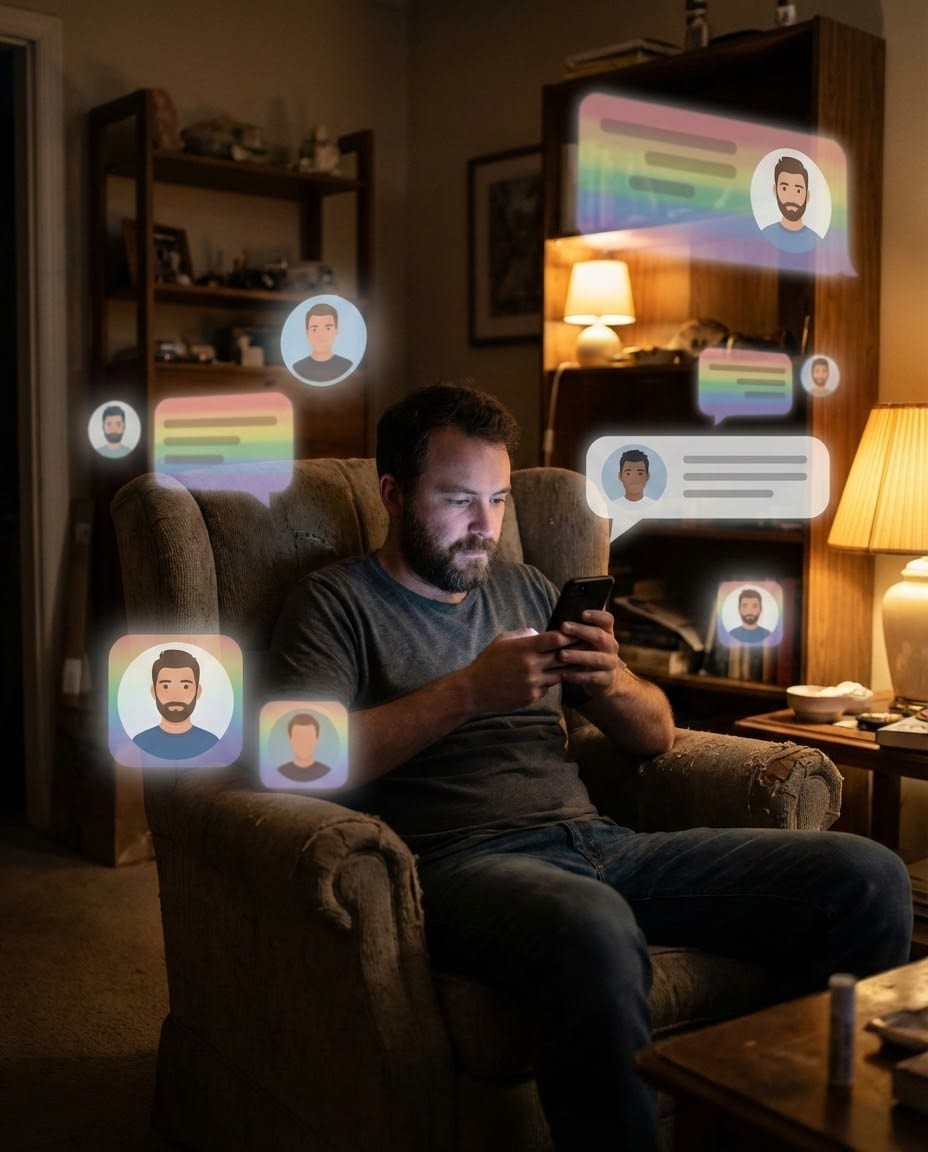
Back in the day, those signals lived in the real world: a look held a second longer, a certain bar at a certain hour, and—famously—the hanky code. In 2026, a lot of that has moved into our phones. Your “flag” might be a couple emojis, a tribe tag, or three words like “hosting, looking, now.”
As the founder and CEO of Splashd, I’m obsessed with making sure our community can connect with more clarity and less risk. This article is a friendly, educational glossary—because decoding “digital hanky codes” shouldn’t feel like taking an exam.
One note before we start: meanings vary by city, age group, subculture, and app. Treat this guide like a map, not a law. When in doubt, ask respectfully.
I’ve seen the best of queer coded language: the kind that helps you find your people. I’ve also seen the worst: confusion, pressure, and risky situations. My goal here is simple—help you read the room without losing the romance.
The original hanky code, briefly (and respectfully)
The hanky code (or handkerchief code) is usually associated with gay male leather culture of the 1970s, though it also spread and evolved beyond that.
At its simplest, it used two variables—color and pocket placement—to communicate interests quickly, especially in spaces where being explicit could be risky.
Here’s the “starter” version most people reference:
| Signal | Common interpretation | Why it mattered |
|---|---|---|
| Bandana color | A specific interest | Fast, discreet shorthand in cruising spaces |
| Left back pocket | Often read as more active/top/dominant | “I’m offering/doing” (very context-dependent) |
| Right back pocket | Often read as more receptive/bottom/submissive | “I’m receiving” (very context-dependent) |
And a few classic color examples you’ll still hear referenced in modern conversations:
Classic hanky examples you might hear referenced
Blue is often cited for oral sex, red for fisting, and yellow for watersports. These were never perfectly universal—region, venue, and community norms mattered then, and they still do now.
To honor that history is to understand the why behind today’s coded language: queer people keep inventing ways to find each other with less friction and more safety.
Why emojis became the new hanky code
Emojis work as a modern hanky code because they’re fast, searchable, copyable, and often “plausibly deniable.” A peach is “just a peach”… until it isn’t. They also help people dodge filters on platforms that aggressively moderate explicit text.
A quick cultural reality check
A lot of “cruising code” is community-created, not app-created. Splashd doesn’t assign meanings to emojis. People do. That’s why context and explicit consent matter more than perfect translation.
There are new risks too. The biggest one in 2026 is that some emojis are used to signal drugs or high-risk situations. We’ll cover that with a harm-reduction lens—because education helps people make informed choices.
The emoji glossary for cruising in 2026
This glossary focuses on common meanings in LGBTQ+ cruising culture and dating contexts. It is not universal, and it’s not a promise of behavior.
The classics
| Emoji | Often used to signal | Notes / nuance |
|---|---|---|
| 🍑 | Bottom | Sometimes “looking to receive,” sometimes just “I’m cheeky.” Context matters. |
| 🍆 | Top | Sometimes used as “hung,” sometimes “I’m a top,” sometimes both. |
| 😈 | Kink / “naughty” / open to taboo play | Can mean anything from playful to intense. Clarify boundaries. |
Leaves and “green” signals
You asked specifically about “leaves,” and yes—this is one of the most misunderstood categories.
| Emoji | Often used to signal | Notes / nuance |
|---|---|---|
| 🍃 / 🌿 | Cannabis / “420 friendly” | Sometimes means “I smoke,” sometimes “I’m okay if you do.” Not always a hookup invite. |
| 🍁 | Cannabis (in some regions) or “Canadian” | Context can be cultural, not substance-related. |
If you’re sober or not interested, you don’t need a speech—just a clear boundary (“Cute, but I’m sober ✨” is a full sentence).
A few other common signals
| Emoji | Often used to signal | Notes / nuance |
|---|---|---|
| 🔥 | Horny / “right now” energy | Can be flirty or pressuring depending on how it’s used. |
| 👀 | Looking / cruising / “I see you” | Often paired with “?” or “now.” |
| 🏠 | Hosting | Sometimes means “I have space,” sometimes “my roommates are gone.” Ask. |
| 🚗 | Can travel | Often paired with “host?” or “where u at.” Ask before assuming urgency. |
| 🧴 | Lube / prep | Not always sexual, but often is in cruising chats. |
| 💦 | Sex / explicit interest | Sometimes just thirst. Sometimes a request. |
Because emoji meanings shift fast, I find it more reliable to think in categories than strict translations:
- Role/position (🍑 🍆)
- Vibe/kink (😈 🔥)
- Logistics (🏠 🚗)
- Substances (🍃 💎 🍦 ❄️)
Substances deserve their own section—because the stakes are higher.
Sexual preferences and vibe signals
Let’s talk about the non-drug side of the digital hanky code: roles, interests, and the “what are you into?” layer.
In 2026, a lot of people prefer quick clarity over a long back-and-forth. That can be healthy (less awkwardness) or it can feel abrupt (less humanity). The sweet spot is: clear, kind, and consent-forward.
Roles and positioning language
🍑 and 🍆 are the headline acts, but you’ll also see profiles use words like top, bottom, vers, side. “Vers” often means flexible, but it doesn’t always mean “anything goes.” “Side” commonly means sex that doesn’t center penetration (and yes, it’s real, and yes, it’s valid).
A small but powerful tip: if someone’s emoji suggests one thing and their text says another, trust the text and ask a simple question.
Hey! Quick check—does 🍑 in your bio mean you’re looking to bottom tonight, or just being cheeky?
Kink signals without the confusion
😈 is the broadest “kink-friendly” signal—which is exactly why it can backfire. One person means “I like spanking.” Another means “I’m into heavy BDSM.” Same emoji, wildly different expectations.
If kink is part of your scene, pairing the signal with one grounding sentence prevents mismatches while keeping the vibe intact (for example: consent expectations, intensity level, and any hard no’s).
And now, the part we need to handle carefully and responsibly: chemsex signals.
Chemsex and substance signals (harm reduction first)
Some emojis are used as drug shorthand in cruising contexts. Seeing them doesn’t mean someone is definitely using, and not seeing them doesn’t mean someone is sober. But recognizing them helps you make informed choices and avoid walking into a situation you didn’t consent to.
Here are the ones you called out:
| Emoji | Often used to signal | What you should know |
|---|---|---|
| 💎 | “Tina” (meth) | Common chemsex shorthand in some scenes. Higher risk for dependency, paranoia, and sexual risk-taking. |
| 🍦 | “Tina” (meth) | Similar meaning to 💎 in certain circles; sometimes used to be extra discreet. |
| ❄️ | Cocaine | Can also mean “snow” generally. Risks include heart strain and mixing dangers. |
You may also see coded terms in text rather than emojis (like “PnP,” “party,” “parTy,” or “T”). Language shifts because people try to avoid detection—and because each city develops its own slang.
How to respond if you see chemsex signals
Harm reduction is about staying safer in the real world (not the perfect world). Whether you’re sober, curious, or experienced, the goal is the same: protect your ability to choose freely, leave safely, and get help if something goes sideways.
A note on safety and support
If substance use is impacting your life—or you’ve had a scary night—you deserve support without shame. Consider reaching out to local LGBTQ+ health centers, harm-reduction services, or substance-use hotlines in your region. Asking for help is a power move.
We can talk about what symbols mean without glamorizing what they represent. Education helps people consent, opt out, and stay safer.
Tribes and “flagging” in the app era
The old hanky code didn’t just signal sex acts—it also helped people find community. The digital equivalent is often “tribes,” labels, and emojis that hint at body type, aesthetic, or subculture.
Two of the big ones you mentioned:
| Tribe label | What it often signals | Common profile clues |
|---|---|---|
| Bear | Often larger and/or hairier; sometimes rugged/masc vibe (not a rule) | Tags like “bear,” “cub,” “daddy bear”; sometimes 🐻 playfully |
| Otter | Often lean-to-average build with body hair; “bear-ish but smaller” (not a rule) | Tag “otter”; sometimes 🦦 now that it’s widely available |
Here’s the thing I want us all to hold gently: tribes can be affirming, but they can also become boxes. Nobody owes anyone a specific look, voice, or level of masculinity to “qualify.”
If you’re on Splashd and you’re not sure what tags to choose, start with what feels true—then add clarity in your own words. The goal is connection, not compliance.
The “hi” hierarchy: looking, hosting, generous, and other loaded openers
In 2026, a lot of cruising talk happens in three-message bursts, and certain words carry way more meaning than they appear to.
Instead of guessing (or spiraling), a good rule is: treat openers as prompts for clarification, not as full agreements.
Flag responsibly: clarity, consent, and staying safe on Splashd
Digital hanky codes can be hot, funny, efficient, and community-building. They can also be misunderstood. “Clarity prevents awkwardness” isn’t just a slogan—it’s how you avoid mismatched expectations and unsafe situations.
Here are four principles I wish we could pin to the top of every chat (without killing the vibe):
- Ask, don’t assume. Emojis are hints, not contracts.
- Be specific about consent. “Into 😈” is not the same as “into impact play; no marks; safe word.”
- Watch for coercion. Pressure, guilt, or repeated pushing isn’t flirting.
- Keep your exit plan. Meet in ways that let you leave easily if anything feels off.
And because Splashd is location-based, here’s a practical reminder: location can be sensitive. If you’re in a small town, closeted situation, or high-risk environment, you can still enjoy connection while protecting yourself—by limiting identifiable details, meeting in public first, and using app safety features.
One more personal note from me: I love queer humor. I love horny little hieroglyphics. I love the playful confidence of a well-placed 🍑. But I love community safety more.
If we’re going to keep evolving our codes, let’s evolve our care, too.
Closing thoughts: keep it cute, keep it clear
The original hanky code was never just about sex—it was about finding each other in a world that didn’t always want us to. In 2026, emojis and tags do that job in a new way: faster, broader, sometimes messier.
So here’s the takeaway I want you to keep: clarity prevents awkwardness, and consent prevents harm.
If you use 🍑, 🍆, 😈, 🍃, 🍦, 💎, ❄️ (or any other signal), consider pairing it with enough context that someone can consent with confidence. And if you’re reading someone else’s profile, remember: the bravest, hottest thing you can do is ask kindly instead of guessing.
If you’re on Splashd, a practical mini-reset that works: update your profile with one clear line about what you’re looking for, choose one boundary you’ll actually keep, use block/report tools when someone crosses the line, and send messages that treat the person like a person—not a symbol.
See you on Splashd,
Rob (Founder & CEO)