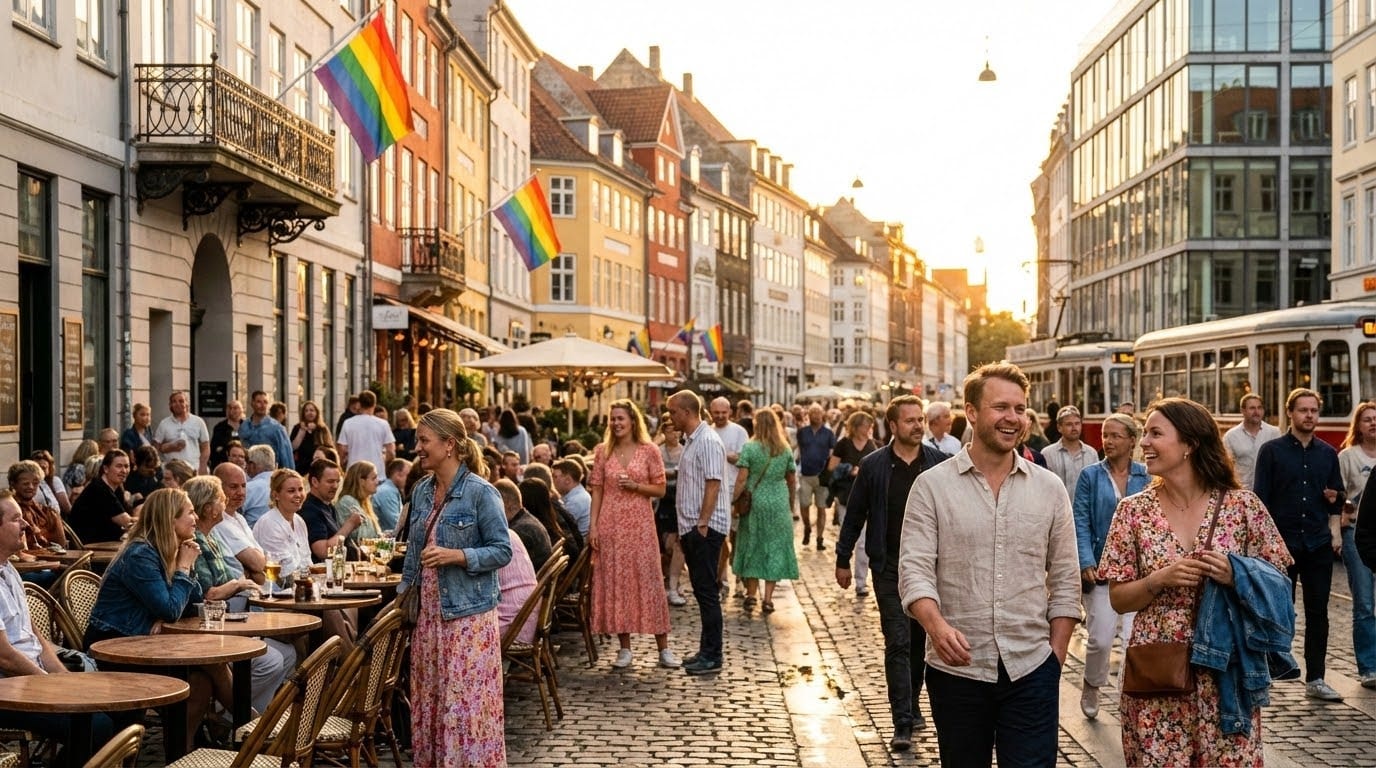

Welcome to the 2026 Safe Travel Index
Post-pandemic travel is fully back. Planes are packed, group chats are buzzing, and every terminal sounds like carry-on wheels and boarding announcements.
For LGBTQ+ travelers, though, that “we’re so back” energy needs a reality check: politics, policing, and social norms can shift quickly—and not always in our favor. A destination can be gorgeous, affordable, and full of nightlife… and still be legally dangerous, socially hostile, or digitally risky—especially when you’re narrowing down LGBTQ travel destinations 2026.
I’m Rob, Founder & CEO of Splashd. I’ve built queer products long enough to know this truth: safety isn’t a vibe—it’s a plan. And in 2026, that plan has to include laws, social climate, and what can happen the moment you open a dating/social app on hotel Wi-Fi—especially if you’re navigating dating app emojis, tribes, and signals.
This is a practical, no-fluff guide to safer travel in 2026—grounded in the 2025 Spartacus Gay Travel Index and major global LGBTQ+ safety reporting, plus the lived reality many of us have felt: some “traditionally safe” places are getting more complicated, while some smaller countries are quietly becoming the gold standard.
A quick note on what this index is (and isn’t)
This is a safety-oriented guide for LGBTQ+ travelers—not a guarantee. Laws and on-the-ground conditions can change quickly. Always check current government travel advisories, and if you’re trans, nonbinary, or gender-nonconforming, factor in ID/document risks and screening realities.
How we built the 2026 Safe Travel Index
Most “best places to visit” lists assume you’re straight, cis, and traveling with a level of default social safety that many of us simply don’t get.
So the 2026 Safe Travel Index uses three lenses:
- Legal safety (biggest weight): Are same-sex relationships criminalized? Are there anti-“propaganda” laws? Are trans identities legally recognized? Are hate-crime protections real and enforceable?
- Social safety: Do local norms tolerate queer couples? Is public harassment common? Are there community spaces where you can breathe?
- Digital safety: Are police known to use dating apps for entrapment? Are phone searches common? Is LGBTQ+ app usage itself a risk factor?
To keep this grounded in credible tracking and reporting, this index leans on:
- The Spartacus Gay Travel Index 2025 (legal and social criteria, plus notable rises/drops):
- ILGA-Europe’s Rainbow Map (2025) (Europe-specific legal/policy scoring, including major drops like the UK):
- ILGA World’s global law tracking (criminalization and death-penalty jurisdictions):
- Credible reporting on digital persecution, app entrapment, and device searches, because what happens on your phone can become “evidence” in the wrong place:
And because safety isn’t theoretical, it’s worth naming what LGBTQ+ travelers report in real life: Booking.com’s LGBTQ+ travel research found that 65% consider safety and wellbeing when choosing a destination, and 59% have experienced discrimination while traveling.
These figures are drawn from ILGA World’s tracking and the Trans Legislation Tracker (see: https://ilga.org/news/pride-month-2025-lgbti-data-maps/ and https://translegislation.com/).
The Green Zone
The Green Zone is where I’d feel comfortable telling most LGBTQ+ travelers (including first-time solo travelers) to start planning with excitement instead of anxiety.
Green Zone does not mean “nothing bad ever happens.” It means you’re far more likely to find some combination of legal protections, visible community, and social norms that don’t punish you for existing.
Why Europe’s top-ranked countries keep showing up
Across recent European rankings, a clear pattern shows up: the same countries keep landing near the top because they’ve done the unglamorous work—anti-discrimination coverage, family rights, conversion practice restrictions, legal gender recognition pathways, and (crucially) consistent policy enforcement.
In ILGA-Europe’s 2025 Rainbow Map, the top of Europe includes Malta, Belgium, Iceland, Denmark, and Spain—with Malta holding #1 for the tenth year in a row.
In the Spartacus Gay Travel Index 2025, leaders include Canada, Malta, Spain, Portugal, and (for the first time) Iceland.
Practically, if you’re building a 2026 itinerary and you want to start from the strongest “baseline safety” options, countries like Malta, Iceland, Spain, the Nordics (Denmark/Norway/Sweden/Finland), and Belgium are the kinds of Green Zone anchors this index is pointing toward.
Malta: small island, big protections
Malta is proof you don’t need a massive country to build a high-safety environment—you need consistent policy and follow-through. Its sustained #1 status in Europe is tied to broad legal protections and strong policy frameworks, reflected in ILGA-Europe’s scoring.
On the ground, that tends to translate to less of the constant internal math many queer travelers do (“Are we okay here?”) and more room to actually relax into the trip.
Iceland: breathtaking nature, meaningful legal gains
Iceland has become a top-tier safety pick in both mainstream perception and formal scoring. In ILGA-Europe’s 2025 Rainbow Map, Iceland holds a top-three spot with a very high score.
Spartacus also calls out Iceland’s arrival among the top leadership group.
If you want quiet, romance, and nature-forward experiences—especially as a couple that doesn’t want to police every gesture in public—Iceland often feels like a deep exhale.
Spain: a Green Zone heavyweight with city + beach options
Spain remains one of Europe’s most reliable Green Zone picks, supported by its top-tier placement in ILGA-Europe’s 2025 ranking.
Spain’s practical advantage is range: you can do major queer city energy (Madrid, Barcelona), coastal resets, and deep cultural travel—making it one of the most reliable picks for best gay vacations 2026 without having to rebuild your safety plan from scratch every time you change cities.
The Yellow Zone
Yellow Zone doesn’t mean “don’t go.” It means: go with a strategy—and don’t assume yesterday’s reputation equals today’s reality.
This is where “falling stars” show up: places many of us grew up thinking of as reliably safe, but that have become more uneven due to legislation, political rhetoric, or rising hostility—especially toward trans and gender-nonconforming people.
The United States: different realities, state by state
I’m based in the U.S., and I’ll say this plainly: the U.S. is not one LGBTQ+ travel destination. It’s dozens of legal climates, plus thousands of local cultures.
In 2025, the Trans Legislation Tracker reported 1,020 anti-trans bills across 49 states, with 125 passed. Separately, broader reporting on 2025 U.S. anti-LGBTQ+ legislation shows hundreds of bills proposed and dozens becoming law.
Even when you’re visiting iconic queer cities, the variance matters. A Pride-heavy metro can feel welcoming while statewide policy becomes hostile, and that gap can show up in healthcare access, ID realities, and what happens if you unexpectedly need help from authorities.
For additional context on public safety reporting, the U.S. Department of Justice hate crime statistics show that in 2024, law enforcement agencies reported 11,679 hate crime incidents with 14,243 victims, and sexual orientation was a significant single-bias category (17.2%).
The UK: a real drop in European rankings
The UK is still home to vibrant queer communities—this isn’t about erasing that. But for a 2026 safety index, trend lines matter.
ILGA-Europe’s 2025 Rainbow Map notes that the UK dropped six places, and the reduced score is linked in reporting to weakening conditions around trans protections (including legal and policy shifts).
On the public safety side, official statistics from the UK government show that in the year ending March 2025, police recorded 18,702 sexual orientation hate crimes and 3,809 transgender hate crimes in England and Wales (with important comparability notes due to recording changes).
So yes: London can be wonderful, and Manchester can be healing. Yellow Zone is simply the reminder to treat the UK like a place where your experience can vary dramatically depending on who you are, where you are, and which systems you might be forced to interact with—healthcare, police, border control, or even late-night transit.
Parts of Eastern Europe: caution means you research like you mean it
“Eastern Europe” isn’t one story. There are queer people everywhere, and there are cities with vibrant scenes and strong community care. But parts of this region sit in the Yellow Zone because legal and political climates can change quickly, and sometimes drastically.
ILGA-Europe’s Rainbow Map reporting also flags a broader pattern: rollbacks in LGBTI rights can be part of wider democratic erosion, and it highlights steep falls connected to anti-LGBTI legislation (including major declines for countries like Hungary and Georgia).
A Yellow Zone planning habit that actually works
Do a “three-tab check” before you book: (1) local LGBTQ+ organizations (what’s happening now), (2) government travel advisories (what authorities believe is risky), and (3) recent local news (what’s changing fast—bans, protests, policing).
The Red Zone
Some destinations are not “edgy.” They are dangerous—meaning the risk isn’t just social stigma. It can be arrest, detention, violence, blackmail, deportation, or worse, including the death penalty in certain jurisdictions.
ILGA World’s 2025 global data notes:
- 64 UN member states criminalise consensual same-sex sexual acts.
- The death penalty is the legally prescribed penalty in 7 UN member states for consensual same-sex sexual acts (with additional countries where legal certainty is unclear).
Those jurisdictions are listed in ILGA World reporting as Brunei, Mauritania, Iran, Nigeria (in 12 states), Saudi Arabia, Uganda, and Yemen.
From the travel-index perspective, Spartacus’ Gay Travel Index 2025 places Saudi Arabia, Iran, Afghanistan, and Chechnya among the bottom-ranked/highest-risk locations.
The hidden Red Zone risk: digital entrapment and device searches
In high-risk environments, your phone can become a liability.
Amnesty International has documented cases where LGBTQ+ people were targeted via phone confiscation, unlawful device searches, and digital evidence used in prosecution, including reports of entrapment and phishing on social media and dating applications.
Reporting on Grindr safety warnings in Egypt also described concerns about police using fake accounts and taking over real accounts after arrests—highlighting how quickly a normal chat can become dangerous if authorities are involved.
So “Red Zone” isn’t only about what happens if you kiss someone in public. It’s also about what happens if someone scrolls your messages at a checkpoint.
A personal note from me, Rob
I’ve traveled with queer friends who had totally different risk profiles than I did. In one city, I could blend in easily; my friend—who is visibly gender-nonconforming—could not. And the scariest moments weren’t dramatic. They were small: a second look from security, an “open your phone” request, the feeling that your normal life is suddenly being evaluated by rules you didn’t agree to.
That’s why this index is structured the way it is: it’s not about judging places—it’s about getting you home safe.
The goal of queer travel isn’t to prove you’re fearless. It’s to protect your freedom—so you can actually enjoy the trip you paid for.
Digital safety abroad
If 2026 has a single travel truth for LGBTQ+ people, it’s this: your digital footprint travels with you.
That matters whether you’re in the Green Zone or the Red Zone. Scams, doxxing, and harassment can happen anywhere; in higher-risk places, the stakes can jump from “embarrassing” to “life-changing.”
1) Reduce what your phone can reveal
Think of this as data minimization: the less your device reveals at a glance, the safer you are in every zone.
Before you travel (ideally 48 hours ahead), do the following:
- Turn off lock-screen message previews.
- Use a strong passcode (not only Face ID / fingerprint).
- Remove apps you don’t need on the trip—especially ones that could reveal LGBTQ+ identity or sensitive communities.
- Back up important data securely.
- Consider traveling with a secondary device if your risk profile is higher.
2) Be careful with VPN advice (useful, not magic)
A VPN can help protect privacy on public Wi-Fi and reduce casual tracking. But VPN legality and enforcement varies by country, and a VPN doesn’t fix risky behavior inside an app (like oversharing your hotel, full name, or travel plans).
Treat VPNs as one layer—not invisibility.
3) Location privacy is dating-app safety
A lot of queer app risk starts with one feature: distance/location. Even in relatively safe places, precise distance can be used to triangulate where you are. In higher-risk environments, it can be used to identify you.
A solid travel rule: don’t share live location or accommodation details in chat, and default to meeting in public first—especially when you’re jet-lagged and emotionally hungry for connection.
4) Watch for the “too perfect” profile pattern
This scam pattern shows up in every zone—and it tends to look like:
- A brand-new account with minimal history
- Extremely attractive photos that feel generic or “model-like”
- Immediate urgency (“come now,” “I’m outside,” “send your number”)
- Pressure to move off-app fast
- Requests for face photos or explicit photos early (especially if your profile is discreet)
In the Green Zone, treat this as a yellow flag. In the Yellow/Red Zones, treat it as a stop sign.
5) Know what “app entrapment” can look like
App entrapment isn’t always a uniformed officer in a sting operation. It can be identity-fishing, screenshot collection for blackmail, pressure toward an unsafe meetup, or manipulative attempts to isolate you.
Amnesty’s reporting on Tunisia includes accounts describing entrapment tactics and phone searches being used against LGBTQ+ individuals.
That’s why digital safety isn’t a “bonus section” of this index—it’s the spine of it.
Splashd travel safety playbook
This is the part I care about most—not just as a founder, but as someone who wants you to experience connection without putting yourself at risk.
Here’s how I recommend using dating and social apps (including Splashd) more safely while traveling in 2026.
Use privacy controls like you’re packing essentials
You wouldn’t pack for Iceland the same way you pack for Ibiza. App settings should be treated the same way: in the Green Zone you might be comfortable being more visible, in the Yellow Zone you tighten visibility, and in the Red Zone the safest move may be not using LGBTQ+ apps at all.
A hard truth about Red Zone travel
If a country is known for criminalization and digital targeting, the safest “camouflage feature” is often simply not opening dating apps there. No connection is worth a legal nightmare.
Put safety into the way you meet
The biggest risk factor isn’t always the country. It’s the unknown person. A safer structure looks like this:
- Make the first meet public (café, busy bar, well-lit place).
- Keep your accommodation private (don’t get picked up at your hotel).
- Keep your transportation independent (so you can leave without negotiation).
- Time-box the first meetup (a short drink is safer than “come over”).
- Tell someone where you’re going (even if it’s one trusted friend back home).
That last point matters. A lot of queer people were trained to smooth things over. Travel is not the time to people-please your way into danger.
Reporting and community care matter
If you see something—an extortion attempt, a suspicious profile pattern, harassment—report it in-app when possible. It helps protect other travelers, especially those who are younger, newly out, or traveling solo for the first time.
And if you’re the experienced traveler in the group, be the friend who sets the tone without apology: “We’re meeting in public first.”
Travel is a right, but safety is a responsibility
I want 2026 to be a year where you say yes to the trip—and yes to the unsexy parts of planning that keep you safe: reading the laws, checking the climate, locking down your phone, using privacy settings intentionally, and trusting your instincts fast.
Because global trend lines are clear. ILGA-Europe is documenting rollbacks in Europe, including major ranking changes and warnings about broader democratic erosion. And ILGA World’s tracking shows that criminalization remains widespread—and deadly in some places.
My closing message, as Rob and as Splashd’s founder: you deserve to explore the world. You deserve romance on vacation. You deserve friendships that start in a new city and last for years. Just don’t confuse a cheap flight with a safe destination, or a friendly message with a trustworthy person.
Use this index like a map. In the Green Zone, pick joy and stay smart. In the Yellow Zone, go with strategy—especially if you’re trans or visibly queer. In the Red Zone, believe the risk and prioritize your life over your curiosity.